



VIEWMONACO JOURNAL
Why Monaco celebrates National Day on 19 November, how the date honours Rainier III, and what its ceremonies and red-and-white traditions represent.
Monaco’s National Day is observed on 19 November, bringing together official ceremony, public displays and community participation. Known as the Sovereign’s Day, the occasion reflects the relationship between the Principality, its institutions and the reigning Prince. Its date is not based on a fixed constitutional anniversary. Instead, it developed through a tradition in which the celebration’s date was associated with the Sovereign.
For residents and visitors, understanding that history helps explain both the significance of 19 November and the formal character of the day. It is also important to separate established traditions from any future programme: accounts of previous celebrations do not constitute a confirmed timetable for 2026 or another forthcoming year.
01
Why Monaco celebrates on 19 November
The Journal de Monaco account of the Fête Nationale explains that the date of the Sovereign’s Day changed over time. Prince Rainier III selected 19 November for the national celebration. When Prince Albert II succeeded him, he chose to retain that date as a tribute to his father.
This decision gives the present date a dual significance. It continues the national observance established during Rainier III’s reign while expressing dynastic continuity under Albert II. The history therefore differs from that of national days tied permanently to a revolution, declaration or single founding event.
The official explanation is the safest basis for interpreting the date. It is not necessary to attach additional anniversaries or unsupported meanings to 19 November: Monaco’s own institutional record identifies Rainier III’s choice and Albert II’s decision to preserve it.
02
A national day centred on ceremony
Monaco’s National Day combines religious, civic and ceremonial elements. The Prince’s Palace report on the celebration of 19 November 2025 documents a thanksgiving Mass at Monaco Cathedral, ceremonies and honours in the Palace courtyard, and a parade on Place du Palais.
These details illustrate the established form of the occasion, but they must be read as a record of the 2025 celebration. They should not be treated as confirmation that the same sequence, access arrangements or timings will apply in 2026. No 2026 public timetable is established by the supplied sources.
The documented components nevertheless show how the day brings several aspects of Monaco’s identity into one observance. The cathedral service represents its religious dimension; the honours and courtyard ceremonies express the role of state institutions; and the parade places part of the celebration in one of the Principality’s most recognisable civic settings.
03
Red and white across the Principality
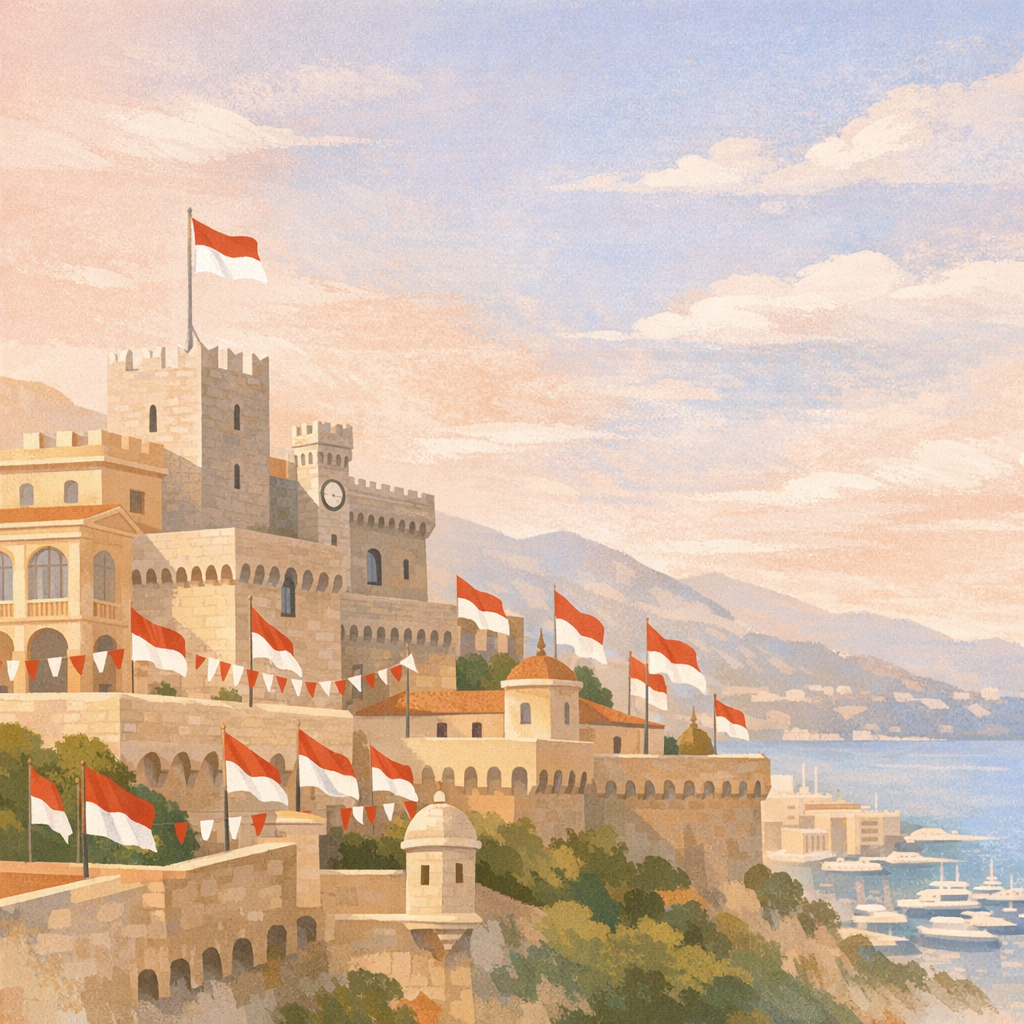
Beyond the formal programme, National Day is marked by Monaco’s national colours. The consular description of Monaco’s traditions notes red-and-white displays, ceremonies and community participation. These visible expressions allow the occasion to extend beyond official proceedings and into the wider Principality.
Red and white provide a straightforward shared symbol during the celebration. Decorations and displays create a recognisable national-day atmosphere, while community participation connects the institutional ceremony with everyday civic life. The effect is not limited to one building or one formal act: the colours help identify the Principality as a whole with the observance.
04
Public viewing and restricted functions
National Day should not be understood as a single event with one access policy. Some aspects can be experienced in public areas, including the general atmosphere, national-colour displays and any proceedings visible from publicly accessible locations. Formal Palace functions, official honours and other controlled ceremonies should not be assumed to be open to everyone.
Invitation-only or restricted functions are distinct from public viewing. A report that dignitaries or participants attended a Palace ceremony does not imply general admission. Equally, the fact that a parade has taken place on Place du Palais does not by itself confirm future viewing zones, entry conditions or capacity.
Anyone planning a visit should rely on current official announcements rather than previous-year accounts. In particular, the supplied research does not support publishing 2026 timings, ticketing details, access rules or a fireworks programme.
05
How to understand the day as a visitor
National Day is best approached as a state and community observance rather than simply as entertainment. The ceremonies place the Sovereign and Monaco’s institutions at the centre, while the cathedral service, honours, parade and national colours provide different expressions of shared identity.
- Use historical reports for context: they explain the traditions but are not future schedules.
- Distinguish visibility from admission: a ceremony may be publicly visible without being open for unrestricted attendance.
- Avoid assuming annual details: timings, routes and access arrangements require current confirmation.
- Expect a formal occasion: the day’s meaning rests on national continuity, ceremony and participation.
For broader practical context, consult the ViewMonaco guide to Monaco. The overview of public holidays in Monaco also places 19 November within the Principality’s annual calendar.
06
A tradition of continuity
The central explanation for Monaco’s National Day is concise: Rainier III chose 19 November, and Albert II maintained it in tribute. The traditions documented in 2025—Mass, Palace ceremonies and honours, and a parade on Place du Palais—show how that continuity is expressed through religion, state protocol and public ceremony.
At the same time, red-and-white displays and community participation give the day a presence beyond its official functions. Together, these elements make 19 November both the Sovereign’s Day and a visible affirmation of Monaco’s national identity.
EXPLORE MORE
Discover more of Monaco
Practical information, local discoveries and trusted guides to the Principality.
