



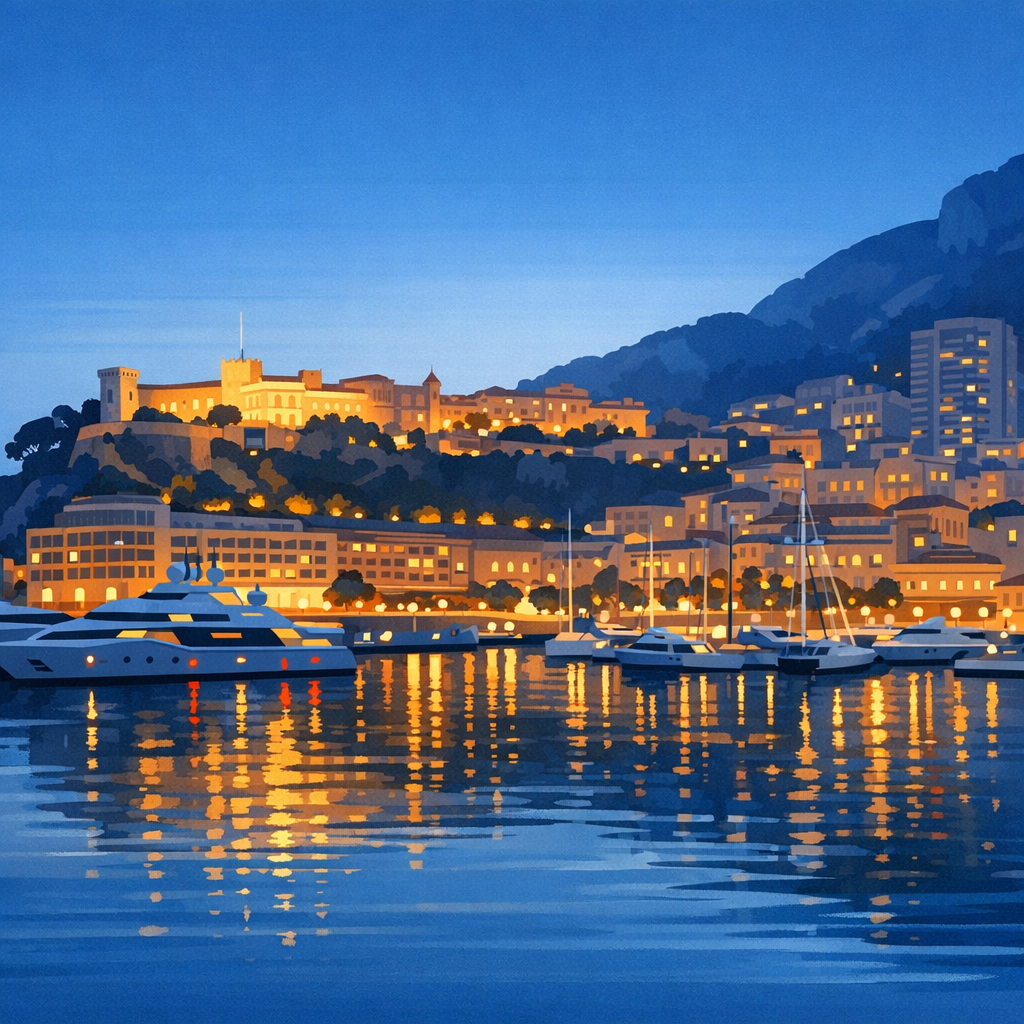
Monaco Guide · Photography Walk
Monaco changes character between late afternoon and nightfall. Stone façades soften, the harbour begins to reflect the city lights and Monte-Carlo takes on its evening polish. This self-guided photography walk uses that short transition deliberately, moving from the elevated streets of Monaco-Ville to Port Hercule and finishing around Place du Casino.
Plan around the light, not the clock
The exact start time should change with the season. Check Monaco’s local sunset time and the weather forecast on the day, then arrive on the Rock with enough daylight to explore calmly. A clear horizon can produce a vivid sunset, but thin cloud often creates softer, more forgiving city light. After sunset, remain out for another 25 to 40 minutes: this is often when the sky retains colour while street and building lights become visible.
The route is intentionally compact, but Monaco’s levels matter. It descends from Monaco-Ville to the harbour before climbing toward Monte-Carlo. If you prefer to conserve energy or protect the timing, use a public lift where convenient or take a bus for one section. Visit Monaco’s official transport information confirms that regular routes connect Monaco-Ville, Port Hercule and Place du Casino; always check the live service before setting out.
One useful decision before you start
Choose whether the evening is about a small set of carefully composed frames or a broader visual diary. Trying to photograph every landmark usually means arriving at the strongest location after the best light has gone.
The three-stage blue-hour route
Monaco-Ville
Begin with pale stone, narrow streets and elevated Mediterranean views. Work with layered rooftops and architectural details before contrast becomes too strong.
Port Hercule
Descend toward the natural harbour at the foot of the Rock. Look for boats, masts, water reflections and the relationship between the port and the city above.
Monte-Carlo
Finish around the Boulingrins Gardens and Place du Casino, where formal landscaping, Belle Époque façades and evening illumination create tighter urban compositions.
Stage one: texture and height in Monaco-Ville
Start around the quieter lanes of Monaco-Ville, then use the edge of the Rock for wider compositions. The district works well before sunset because its warm façades, shaded passages and open viewpoints offer variety without requiring long distances. Rather than pointing the camera only toward a famous building, include a foreground element such as a wall, planting or a turn in the street to give the image depth.
If daylight and opening conditions allow, the Saint-Martin Gardens add winding paths, sculptures and sea-facing viewpoints between the Cathedral and the Oceanographic Museum. Official visitor information notes that parts of the gardens are steep, so allow more time than the map suggests and never rush a descent for the sake of a frame. Gates and access hours can change; check the current official details before relying on the gardens as your only route.
Photographers interested in façades can extend the idea with ViewMonaco’s Belle Époque architecture walk, but keep this evening route focused: one strong architectural detail is more useful than a hurried catalogue.
Stage two: sunset beside Port Hercule
Move down toward Port Hercule as the sun approaches the horizon. Visit Monaco describes the harbour as a natural bay at the foot of the Rock, a geography that creates several layers in a single view: water and boats in front, quays and buildings in the middle, then Monaco-Ville rising behind.
Use the harbour’s lines rather than chasing a completely unobstructed panorama. Mooring lines, masts and quay edges can lead the eye through the frame. As artificial lights appear, watch the water for broken reflections; a slightly slower shutter can turn them into streaks, while a faster exposure retains texture. Brace the camera securely and stay clear of working areas and pedestrian flows.
For a phone
Clean the lens, tap to expose for the brightest façade and hold the phone against a stable surface for the darker frames.
For a camera
Carry one versatile lens, enable stabilisation when appropriate and review highlights rather than judging the image only by screen brightness.
For reflections
Change your height and angle before changing equipment. A small move along the quay can separate lights that overlap in the water.
For people
Use figures for scale, but respect privacy and avoid intrusive close-ups. Do not block entrances, paths or viewpoints while composing.
Stage three: Monte-Carlo as the sky deepens
Make the final move toward the Boulingrins Gardens and Place du Casino before the remaining colour leaves the sky. The Casino Gardens slope toward the square and offer planted foregrounds, while the surrounding façades reward symmetrical and detail-focused compositions. This is also the busiest part of the route, so work lightly and keep equipment close.
Blue hour is brief. Begin with the widest composition you want, then move closer for doors, canopies, stonework and pools of light. Mixed lighting can shift colours dramatically; if the result looks unnatural, keep white balance consistent across a short series and refine it later rather than changing settings for every frame.
For a longer non-photography route through the same part of town, see an evening in Monaco without the casino. It provides a useful companion plan when the walk is also about dinner, gardens and atmosphere.
A simple shot list that keeps the walk moving
Six frames are enough for a coherent story
- An establishing view from Monaco-Ville.
- A street detail showing texture or scale.
- The Rock and harbour in the same composition.
- A close study of masts, boats or reflected light.
- A blue-hour cityscape in Monte-Carlo.
- One final architectural detail after dark.
If the weather turns or the light is flat, switch the emphasis from skyline colour to surfaces, geometry and human scale. Wet paving can be useful; haze can simplify distant layers. The route should remain enjoyable even when the evening does not produce the postcard conditions you expected.
Practical checks before leaving
Wear shoes suited to slopes and polished paving, travel with a light bag and keep valuables under control in busy public spaces. Confirm current garden access and public transport information through official sources. If using a tripod or planning any commercial production, verify permissions with the relevant authority or property operator in advance; do not assume that casual visitor access grants production rights.
The walk can also be shortened. For a single-location session, choose Port Hercule for reflections and broader city layers, or Monte-Carlo for formal architecture and evening detail. ViewMonaco’s guide to free things to do in Monaco offers more public-space ideas for building a daytime companion route.
Continue planning your Monaco evening
Pair the photography route with a relaxed after-dark plan through gardens, the harbour and Monte-Carlo.
