



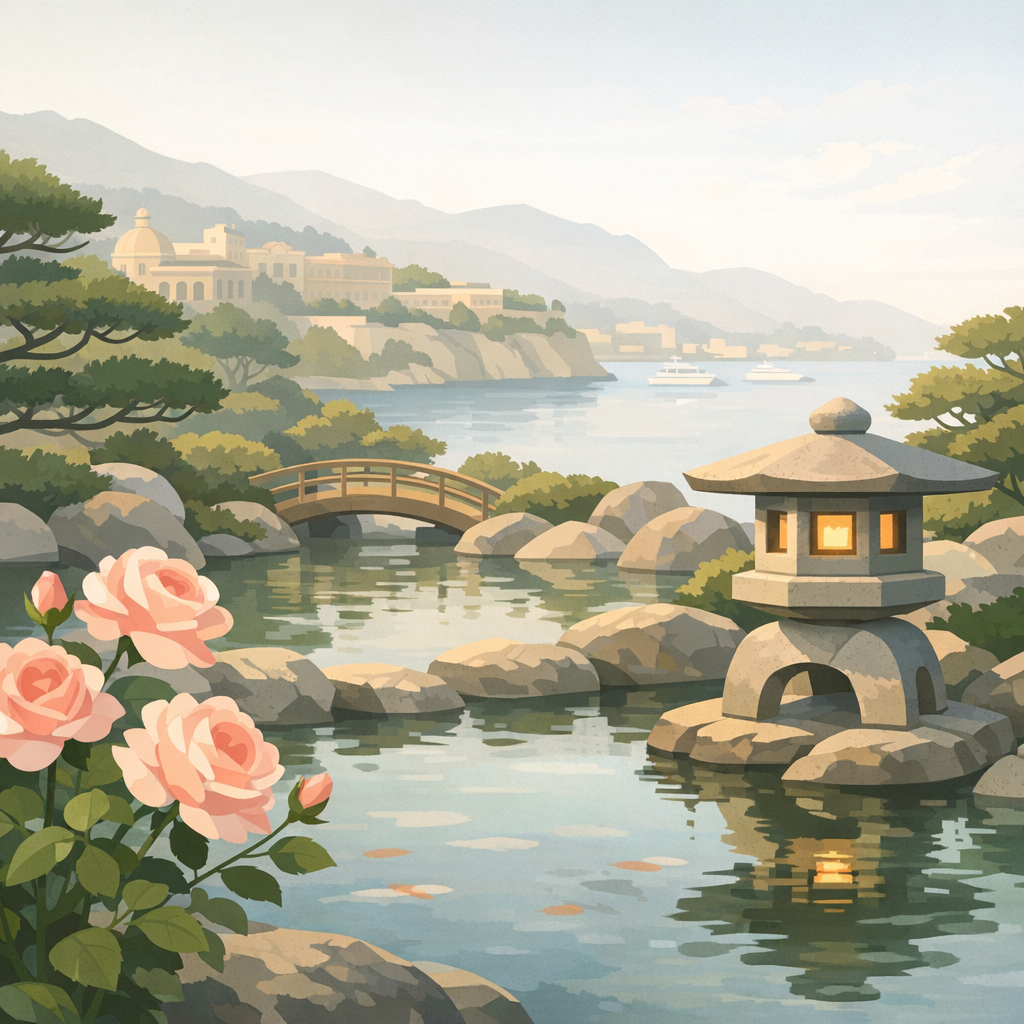
Monaco Guide · Gardens and Urban Landscape
Two of Monaco’s most distinctive gardens sit at opposite ends of the Principality. Begin beside the sea in the Japanese Garden, then cross the city to Fontvieille and finish among the roses planted in memory of Princess Grace. The result is not simply a garden checklist, but a revealing half-day through two very different ideas of landscape.
Why put these two gardens in one itinerary?
They are complementary rather than interchangeable. The Japanese Garden compresses an idealised natural world into a carefully framed sequence of water, stone, planting and shelter. The Princess Grace Rose Garden is more open: a memorial landscape where individual varieties, scent and seasonal flowering reward a slower circuit.
Visiting both also gives useful geographic context. The first sits on Monaco’s eastern side, close to the Grimaldi Forum and the waterfront at Larvotto. The second is in Fontvieille, the western district created on land reclaimed from the sea. Travelling between them turns the day into a cross-section of the Principality.
Japanese Garden
Designed as a stylised landscape, the garden covers about 7,000 square metres. Its central lake, waterfall and curving path reflect three fundamental elements described by its Japanese designer: surface, point and line.
- Look for the change from open waterfront to enclosed garden rooms.
- Notice how Mediterranean and subtropical plants support a Japanese composition.
- Allow time to sit; this garden works through pauses and framed views.
Princess Grace Rose Garden
Created at the request of Prince Rainier III in memory of Princess Grace, the garden combines an English-garden influence with a Mediterranean setting and mature olive trees.
- More than 315 rose varieties are arranged across themed sections.
- The central fountain and bronze statue give the garden a clear focal point.
- QR codes and the on-site terminal help identify individual roses.
The route, in three unhurried stages
A practical east-to-west plan
Start with the Japanese Garden
The most rewarding first impression comes from contrast. Avenue Princesse Grace is urban and open to the Mediterranean; inside the garden, the scale tightens. Paths bend rather than reveal everything at once, while stone, water and planting create a sequence of smaller scenes.
Do not treat the tea house, bridges and waterfall as isolated photo stops. The design is better understood as a composition. Move once around the lake, then repeat part of the circuit more slowly and notice how the same elements align differently from each side.
The official Visit Monaco accessibility guide describes much of the garden as accessible, but surfaces, bridges and maintenance arrangements may affect an individual route. Anyone relying on step-free access should check conditions at the entrance and avoid assuming that every small path will be suitable.
Cross Monaco without turning the transfer into a test
Walking all the way is possible for confident urban walkers, but it is not the best default for this itinerary. Monaco’s short map distances hide changes of level, busy junctions and indirect pedestrian connections. Saving energy for the gardens usually produces a better visit.
The official CAM network lists line 6 between Fontvieille and Larvotto, making it the most useful public-transport option for this east-west pairing. Routes, stop patterns and traffic arrangements can change during major events, so consult real-time information on the day. A taxi is the simplest alternative when time or mobility matters more than cost.
Finish among the roses in Fontvieille
The Princess Grace Rose Garden has a more expansive rhythm. According to its official Visit Monaco profile, the present garden covers about 5,000 square metres and contains around 6,000 rose bushes. The collection is organised thematically, so the visit is as much about comparison as colour.
Flowering intensity changes with the season and weather. When fewer roses are in bloom, the mature olive trees, water features, sculpture and broader Fontvieille landscape still give the garden structure. It is therefore worth visiting outside peak flowering periods, provided expectations are realistic.
The garden and Fontvieille Park are free to enter and open around the clock according to Visit Monaco. The same source describes gentle slopes, wheelchair access and accessible toilets. Temporary maintenance or event arrangements may still affect individual areas.
Choose the right version of the day
For garden lovers
Give each garden at least an hour, carry a small notebook or use plant-identification information on site, and skip extra landmarks.
For photographers
Use softer morning light in the Japanese Garden and save detail shots of roses for later. Avoid blocking narrow paths or staged portrait sessions.
For reduced walking
Use public transport or a taxi for the cross-town section. Confirm the most convenient entrance and current accessible route at both gardens.
For families
Keep the garden visits short and extend the Fontvieille finish into the surrounding park only if children still have energy.
Small choices that improve the visit
Stay on marked paths, keep voices low in enclosed areas and do not touch plants or decorative elements. In the Rose Garden, use the identification tools rather than handling blooms. Bring water, but treat benches and shaded areas as shared space rather than picnic territory unless signs clearly permit otherwise.
Because both gardens are living public spaces, seasonal work is part of the experience. A closed path, recent pruning or quieter flowering period does not make the visit a failure; it reveals the maintenance behind Monaco’s carefully managed landscapes.
Explore Monaco’s green spaces
Compare the Principality’s principal gardens, choose the right district and build another route around the landscape that interests you most.
