



VIEWMONACO JOURNAL
Learn to distinguish Monaco’s red-and-white national flag, the elaborate princely arms, the motto Deo Juvante and other official insignia.
Monaco’s national symbols are easy to recognise once their roles are separated. The red-and-white flag, the elaborate princely arms and the motto Deo Juvante are related expressions of identity, but they are not interchangeable. This guide explains how to identify them accurately, where authoritative descriptions can be found and why official insignia should be treated carefully in commercial contexts.
01
How to identify Monaco’s national flag
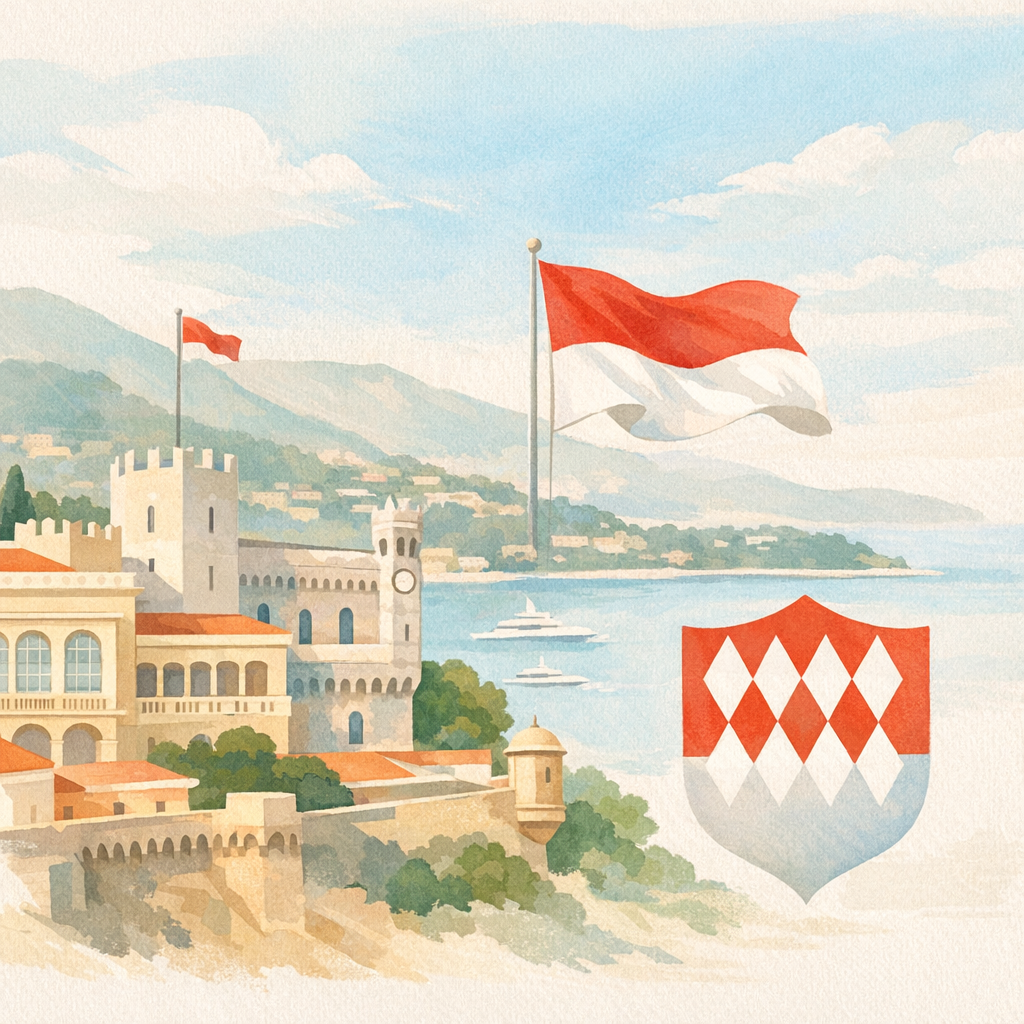
Monaco’s national flag consists of two horizontal fields: red above white. This simple arrangement is the essential identifying feature given by Monaco’s diplomatic information service. It should not be confused with the much more detailed composition of the princely arms.
When describing the flag in words, “horizontal red over white” is clear and sufficient. Adding a shield, crown, supporters, motto or decorative mantle would turn the description into something other than the plain national flag. The diplomatic source also discusses Monaco’s other national markers, including the musical and lyrical history of the anthem, and can be consulted through its official overview of Monaco’s national specifics.
02
The composition of the princely arms
The Prince’s Palace description of the Grimaldi coat of arms identifies a considerably more complex design. At its centre is a silver shield bearing red lozenges. Around and above that central element are the collar of the Order of Saint-Charles, an ermine-lined red mantle and a crown.
The arms also have two sword-bearing monks as supporters. Beneath the composition appears the motto Deo Juvante. Each component belongs to the full heraldic description; none should be assumed to be part of the simple red-over-white national flag.
Written identification is often more useful than an approximate illustration. A verbal account can distinguish the shield, mantle, crown, collar, supporters and motto without reproducing an official emblem inaccurately. It also avoids reducing the arms to the red-and-white colours alone.
03
What Deo Juvante means
The princely motto is Deo Juvante, translated by the Palace as “With God’s Help.” It appears as part of the armorial composition described by the Prince’s Palace and should therefore be understood in that specific context.
The motto is not a substitute name for the flag, nor does it describe the flag’s arrangement. It is one element of the princely arms. Keeping that relationship clear helps prevent a common category error: treating every national or dynastic symbol as though it were a version of the same object.
04
Flag, arms and state insignia: the practical distinction
The simplest distinction is visual and functional. The national flag is the horizontal red-over-white design. The princely arms are the full heraldic composition centred on the silver shield with red lozenges and accompanied by the other elements described above. State insignia is a broader category of official symbolism and should not automatically be treated as identical to either the plain flag or the complete arms.
This distinction matters when labelling photographs, writing captions or preparing visitor information. A red-and-white banner should not be called the coat of arms. Likewise, an image containing the crowned shield, monks and motto should not be described merely as the national flag.
Readers clarifying the relationship between the country and its best-known district may also find Monaco vs Monte-Carlo: the difference explained useful. For broader orientation, see the ViewMonaco guide.
05
The anthem as a separate national marker
Monaco’s anthem belongs to the same broad field of national symbolism, but it is neither a flag nor a coat of arms. Monaco’s diplomatic site treats its musical and lyrical history separately from the flag’s visual description. That separation is useful: national identity can be expressed through music and words as well as through colours and heraldry.
Detailed claims about the anthem’s chronology, authorship or versions should be checked against the official diplomatic account rather than inferred from the flag or arms.
06
Using official symbols responsibly
Monaco Law No. 716 protects uses of official arms and symbols. The legislation includes authorisation requirements for certain commercial reproductions, so finding an emblem online should not be taken as permission to place it on merchandise, advertising, packaging or other commercial material.
The precise legal position depends on the proposed use. Anyone considering reproduction should consult the text of Law No. 716 on Legimonaco and seek appropriate professional guidance where necessary. This overview identifies the issue but is not legal advice.
- For identification: look for horizontal red over white on the national flag.
- For the princely arms: identify the silver shield with red lozenges and the surrounding heraldic elements.
- For the motto: use Deo Juvante, meaning “With God’s Help.”
- For reproduction: do not assume that official status means unrestricted commercial use.
EXPLORE MORE
Discover more of Monaco
Practical information, local discoveries and trusted guides to the Principality.
