



Monaco Guide · Cinema Walk
Monaco has played itself on screen for generations: as a stage for casino intrigue, motor racing, Mediterranean glamour and stories in which appearances matter. This self-guided walk uses that film history as a lens, linking Casino Square, the Grand Prix streets and Port Hercule before an optional visit to the Principality’s audiovisual archive.
Film geography is slippery. A story may be set in Monaco while interiors or action scenes were made elsewhere, and a recognisable exterior may appear for only seconds. This walk identifies verified Monaco cinema connections and treats the city itself as the subject; it does not claim that every nearby scene was filmed on the exact paving stone where you are standing.
Why Monaco looks made for cinema
Monaco compresses several powerful visual ideas into a very small territory. Belle Époque façades face modern towers; formal gardens open onto the Mediterranean; a harbour becomes part of a racing circuit; and the streets rise so quickly that a camera can move from water level to a grand urban panorama in minutes.
The Institut audiovisuel de Monaco describes the Principality as a “living set” and traces its screen history through films including Le Roman d’un tricheur (1936), The Red Shoes (1948), The Racers (1955), Bay of Angels (1963), Weekend of a Champion (1972), Never Say Never Again (1983) and Priceless (2006). The variety matters: Monaco on screen is much more than one spy franchise.
The self-guided cinema route
Begin in Casino Square
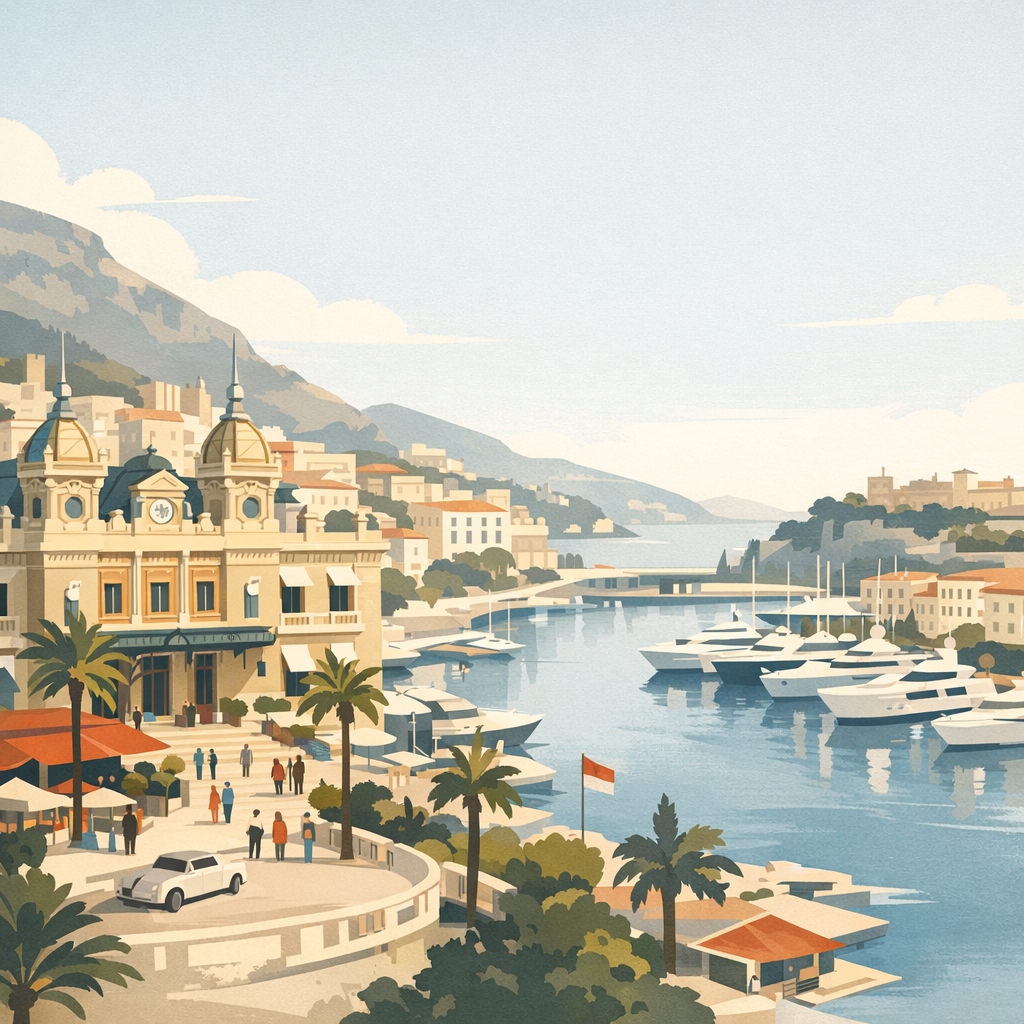
Start outside the Casino de Monte-Carlo and take in the whole composition before focusing on a single building: the Casino, Hôtel de Paris, Café de Paris, gardens, terraces and arriving cars all contribute to the square’s theatrical character. It functions almost like a ready-made establishing shot.
The Casino is Monaco’s clearest James Bond location. Société des Bains de Mer’s own material connects the venue with Sean Connery in Never Say Never Again and Pierce Brosnan in GoldenEye. Even without entering, the façade and forecourt make the screen association immediately legible.
Read the square like a film set
Walk slowly around the edge of the square and notice how movement is controlled. The curved approaches delay the reveal; polished façades reflect one another; gardens soften the stone; and the open centre gives vehicles and people a natural stage. For photographs, look for layered frames rather than trying to reproduce a specific shot.
If you plan to visit the Casino interior, check the official Casino de Monte-Carlo information on the day. Visiting periods, admission rules, age restrictions and dress expectations can change, and gaming-room access is different from simply viewing the exterior.
Descend towards the racing streets
Continue downhill towards the harbour, using the public streets that form part of Monaco’s motor-racing identity. Outside race preparations and event closures, this is an ordinary working city: use pavements and crossings, and never treat the route as a track.
Motorsport gave filmmakers a second Monaco vocabulary: speed, mechanical tension and spectators pressed close to the action. The Institut’s cinema timeline includes The Racers and Roman Polanski’s documentary Weekend of a Champion. The latter follows Jackie Stewart around the 1971 Monaco Grand Prix weekend, turning the city circuit into both workplace and character.
Pause at Port Hercule
At the harbour, turn back towards Monte-Carlo. This reverse view explains why Monaco’s screen image feels larger than its geography: yachts, grandstands during race season, steep urban slopes and the Casino district occupy the same frame.
Port Hercule is also where the city’s casino and racing personas meet. Rather than chasing an exact screenshot, watch how roads, quays and water connect. That relationship is the lasting cinematic subject.
Add the Institut audiovisuel
For context beyond famous exteriors, make the Institut audiovisuel de Monaco an optional second chapter. Its “Monaco en films” timeline uses films, production photographs, posters and magazines to explain twenty moments in the relationship between Monaco and cinema. The institute is at L’Engelin, 83–85 boulevard du Jardin Exotique, away from the core walking route.
Opening arrangements and exhibitions can change, so check the official programme before travelling there. The institute also organises screenings and archive-based programmes that explore how Monaco’s urban fabric and coastline have changed on film.
A short Monaco watchlist
Never Say Never Again (1983)
Useful before the walk for its direct Casino de Monte-Carlo connection and for the way it turns Monte-Carlo elegance into suspense.
GoldenEye (1995)
The Monaco passage combines the Casino, harbour atmosphere and high-stakes action into a compact portrait of the Principality.
Weekend of a Champion (1972)
A valuable record of Jackie Stewart and the Monaco Grand Prix, capturing the circuit before today’s event infrastructure.
Bay of Angels (1963)
Jacques Demy’s film belongs to the wider Riviera casino imagination and appears in the Institut’s official Monaco cinema timeline.
Practical notes for the walk
- Choose a normal weekday or non-event period if you want the clearest reading of the streets.
- Expect gradients and changes of level; public lifts can reduce some climbs, but the route still requires comfortable walking shoes.
- Keep photography discreet around Casino entrances, security points and private guests.
- During Grand Prix build-up, race weekends or dismantling, barriers and pedestrian diversions can substantially change the route.
- Check official venue information rather than relying on a film-era detail for present-day access.
Look beyond Bond
Bond is the easiest entry point, but the deeper pleasure of this walk is seeing how different filmmakers have used the same compact landscape. Monaco can suggest modernity, nostalgia, risk, wealth, performance or escape, sometimes within the same sequence. The Institut’s archive makes clear that this relationship predates the modern blockbuster and includes documentary, drama and European art cinema.
For more context on the district around the first stops, continue with the ViewMonaco guide to Monte-Carlo. For a broader sightseeing plan, the Published Monaco attractions guide helps connect this cinema route with museums, gardens and landmarks.
Official sources used
Build the rest of your Monaco day
Pair the cinema walk with a museum, garden or waterfront stop, using ViewMonaco’s Published guide to shape a route that fits your time.
